Tax
£100k Childcare Cliff: Work Out Your Adjusted Net Income (UK)
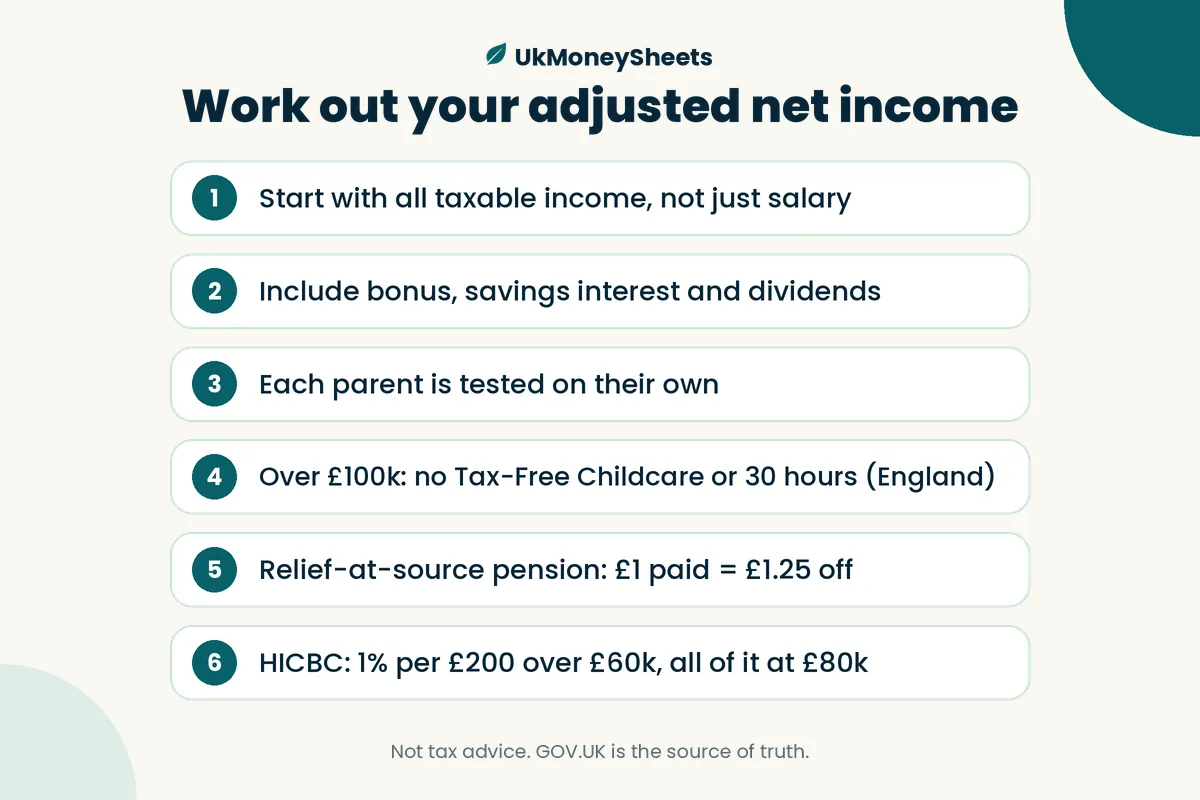
You lose Tax-Free Childcare and England's 30 hours of free childcare if you or your partner expect adjusted net income over £100,000 this tax year — and that's your total taxable income (pay, bonus, savings interest, dividends, side-hustle profit) minus certain reliefs, not your salary. Paying into a relief-at-source pension lowers it by the grossed-up amount (£1 paid = £1.25 off), as does Gift Aid, while net-pay and salary-sacrifice contributions are already out of your taxable pay. The same figure sets the High Income Child Benefit Charge (1% for every £200 over £60,000, all of it at £80,000) — and the Conservative pledge to scrap the £100k cliff hasn't changed any of these rules.
General information, not tax, pension or financial advice. Rules are from GOV.UK for the 2026/27 tax year — check the linked pages or a regulated adviser before changing pension contributions. Example figures are made up for illustration.
The £100k childcare cliff in one minute
Adjusted net income (ANI) is your total taxable income before Personal Allowances, less certain reliefs such as pension contributions and Gift Aid (GOV.UK: adjusted net income). It's the number that decides all three thresholds in this guide.
Who loses what if either parent's expected ANI is over £100,000 for the current tax year:
- Tax-Free Childcare (UK-wide): the government adds £2 for every £8 you pay in, up to £500 per child every 3 months (£2,000 a year), or £1,000 every 3 months (£4,000 a year) if your child is disabled. Your child must be 11 or younger (16 or younger if disabled). You're not eligible if you or your partner expect ANI over £100,000 for the current tax year (GOV.UK: Tax-Free Childcare eligibility).
- Free Childcare for Working Parents — the "30 hours" (England): for children aged 9 months to 4 years, 30 hours a week for 38 weeks a year. Same test: not eligible if you or your partner expect ANI over £100,000 for the current tax year (GOV.UK: 30 hours free childcare).
- What stays: all 3- and 4-year-olds in England still get 15 hours a week regardless of income.
Three things about the test that people often get wrong:
- It's per parent. Each parent's ANI is tested on its own. One parent over £100,000 is enough to lose eligibility, even if the other earns much less. It is not a test of your combined income.
- "Over" means over. The rule is ANI over £100,000, so exactly £100,000 isn't over the limit.
- It's "expected" ANI for the current tax year (6 April 2026 to 5 April 2027), and you reconfirm every 3 months.
Rules unchanged — pledge only. On 3 October 2026, Conservative leader Kemi Badenoch said a Conservative government would scrap the £100,000 "cliff edge" for 30 hours' funded childcare and Tax-Free Childcare in England (BBC News). The Conservative proposal is an opposition pledge; it is not law. The rules below are the ones that apply today.
What adjusted net income is (GOV.UK's 4 steps, in plain English)
Step 1: add up your taxable income ("net income")
Include things like:
- Employment pay and benefits in kind (your P11D items, such as a company car)
- Bonuses
- Self-employment profit — including selling through websites or apps (see our side-hustle Self Assessment guide for working out profit)
- Some rental income
- Savings interest
- Dividends
- Most pensions, some state benefits, trust income and foreign income
Then take off pension contributions paid gross (made without tax relief) and trading losses.
Step 2: take off Gift Aid, grossed up
For every £1 you donate through Gift Aid, take £1.25 off.
Step 3: take off relief-at-source pension contributions, grossed up
For every £1 you pay into a pension where the provider has already added basic-rate relief, take £1.25 off.
Step 4: add back trade union or police superannuation relief
If you took off relief of up to £100 for these payments in step 1, add it back.
GOV.UK's own examples: Bill has £115,000 of income and pays £10,000 into a pension without tax relief, so his ANI is £105,000. Clara has £70,000 of income, pays £4,750 into a pension without tax relief and gives £1,000 through Gift Aid (£1,250 grossed up), so her ANI is £64,000.
How pension contributions change your ANI
How much a contribution moves your ANI depends on how it's paid. Check your payslip and P60 to see which type you have.
| How you pay in | What happens to tax | Effect on ANI |
|---|---|---|
| Net pay arrangement (workplace pension taken before tax) | Your employer takes it out of your pay before deducting Income Tax | Already left out of your taxable pay on your P60 — don't deduct it again |
| Relief at source (all personal and stakeholder pensions, including SIPPs, and some workplace schemes) | You pay in; your provider adds 20% | Deduct the grossed-up amount: × 1.25 (£4,000 paid = £5,000 off) |
| Salary sacrifice | Your contractual cash pay is reduced | The sacrificed amount never enters taxable pay — don't deduct it again |
The double-count mistake
If your pension comes out under net pay or salary sacrifice, your taxable pay figure is already lower. Deducting the contribution a second time makes your ANI look lower than it really is — which is the last thing you want near £100,000.
Higher-rate relief
With relief at source, your provider only adds basic-rate relief. Higher and additional-rate taxpayers claim the extra relief through Self Assessment (or HMRC's claim service) (GOV.UK: pension tax relief). If you've never filed a return, see our guide to registering for Self Assessment.
Limits in one line
Tax relief is limited to contributions worth up to 100% of your annual earnings, and the annual allowance is £60,000 (lower only if your threshold income is over £200,000 and your adjusted income is over £260,000) (GOV.UK: annual allowance). Salary sacrifice can't take your cash pay below the National Minimum Wage — your employer handles that (GOV.UK: salary sacrifice).
Gift Aid and other deductions
- Gift Aid: the charity claims 25p for every £1 you give, so for ANI you deduct £1.25 per £1 donated. Higher-rate donors can claim back the difference through Self Assessment or a tax-code change. Your donations must not be more than 4 times the tax you've paid that year (GOV.UK: Gift Aid).
- Payroll Giving: taken before Income Tax, so it's already outside your taxable pay. Don't deduct it again.
- Trading losses: come off at step 1.
The three thresholds on one chart
All three use the same ANI figure for the 2026/27 tax year.
| ANI | What happens | Source |
|---|---|---|
| Over £60,000 up to £80,000 | High Income Child Benefit Charge: 1% of your Child Benefit for every £200 over £60,000 | GOV.UK |
| £80,000 and above | Charge equals all of your Child Benefit | GOV.UK |
| Expected ANI over £100,000 (either parent) | No Tax-Free Childcare; no 30 hours in England (15 universal hours for 3–4s stay) | GOV.UK |
| Over £100,000 up to £125,140 | Personal Allowance (£12,570) cut by £1 for every £2 over £100,000 | GOV.UK |
| £125,140 and above | Personal Allowance is zero | GOV.UK |
Income tax bands are different in Scotland (GOV.UK).
Work it out: the ANI worksheet
Made-up figures for illustration. Not advice — check GOV.UK or a regulated adviser.
Build this in Google Sheets with one column per parent, so each parent's ANI is checked separately.
Rows
- Employment taxable pay (after net-pay or salary sacrifice — from your payslip or P60)
- Bonus / benefits in kind
- Self-employment profit
- Property profit
- Savings interest
- Dividends
- Other taxable income
- = Net income before reliefs
- Less gross pension contributions paid without relief
- Less trading losses
- Less Gift Aid × 1.25
- Less relief-at-source pension contributions × 1.25
- Add back union or police relief
- = ANI
Flags and formulas
- Childcare limit:
=IF(ANI>100000,"Over £100k","Within") - Personal Allowance:
=MAX(0,12570-MAX(0,ANI-100000)/2) - HICBC %:
=MIN(100,MAX(0,INT((ANI-60000)/200)))— counts only complete £200 steps (see the rounding note below) - Annual Child Benefit:
=Weekly_rate*Weekly_payments— enter your total weekly rate (£27.05 for the eldest or only child, plus £17.90 for each additional child) and the number of weekly payments in the tax year: 53 for 2026/27 (most tax years have 52) - HICBC £:
=ROUNDDOWN(HICBC_pct/100*Annual_Child_Benefit,0)— rounds down to whole pounds, matching the GOV.UK calculator - Target ANI (an input you choose), then:
Gross reduction needed = MAX(0, ANI − Target)Relief-at-source payment = Gross reduction × 0.8
Example A: the childcare cliff (parent in England, child aged 2)
| Step | Figure |
|---|---|
| Salary £104,000 + bonus £3,000 (no net-pay pension in this example) | £107,000 taxable pay |
| Plus savings interest | £1,000 |
| Net income | £108,000 |
| Gift Aid paid £400 → grossed up | £500 off |
| ANI | £107,500 |
| Childcare check | Over £100k: no Tax-Free Childcare or 30 hours |
| Personal Allowance | Cut by £3,750 to £8,820 |
Now set a target ANI of £99,000 (a buffer this parent chooses — not a recommendation):
- Gross reduction needed: £107,500 − £99,000 = £8,500
- Relief-at-source payment: £8,500 × 0.8 = £6,800; the provider adds £1,700
- ANI after: £99,000 → within the £100k childcare limit, and the full £12,570 Personal Allowance is restored
- Higher-rate relief on the contribution is claimed through Self Assessment
- The Child Benefit charge is still 100% at £99,000 (it's over £80,000). With one child, Child Benefit for 2026/27 is £27.05 × 53 = £1,433.65, so the charge is £1,433 (rounded down to whole pounds)
- The partner's ANI is checked separately in the second column
Example B: the Child Benefit charge taper (two children)
| Scenario | ANI | Charge % | Charge |
|---|---|---|---|
| No extra pension | £72,000 | (£72,000 − £60,000) ÷ £200 = 60% | 60% × £2,382.35 = £1,429.41 → £1,429 |
| Relief-at-source payment £4,800 (gross £6,000) | £66,000 | 30% | 30% × £2,382.35 = £714.705 → £714 |
| Relief-at-source payment £9,600 (gross £12,000) | £60,000 | 0% | £0 |
Child Benefit in this example: (£27.05 + £17.90) × 53 = £2,382.35 for 2026/27 (rates from GOV.UK: what you'll get). The 2026/27 tax year has 53 weekly Child Benefit payments; most tax years have 52. Charges are rounded down to whole pounds. When we ran these examples through the GOV.UK Child Benefit tax calculator in October 2026, it gave the same figures.
Note: pension money is locked away until pension age. This shows the arithmetic only — it isn't a suggestion to pay in any amount.
The High Income Child Benefit Charge part
- Threshold: ANI over £60,000 (from 2024/25).
- The charge: 1% of your Child Benefit for every £200 over £60,000; all of it once your ANI is £80,000 or more.
- Who pays: if both partners are over £60,000, the one with the higher ANI pays.
- How to pay: through PAYE or Self Assessment. If you already file a return for another reason, you must pay it through Self Assessment.
- Opting out: you can stop the payments but stay registered for Child Benefit. That keeps your National Insurance credits, which count towards your State Pension.
(GOV.UK: High Income Child Benefit Charge)
A note on rounding
GOV.UK's guidance gives the rule as "1% for every £200" without spelling out rounding. When we tested the GOV.UK Child Benefit tax calculator for 2026/27 in October 2026, it counted only complete £200 steps (part of a £200 step didn't add another 1%) and showed the estimated charge rounded down to whole pounds. For 2026/27 it counted 53 weekly payments (£1,433.65 for one child, £2,382.35 for two), which is what the examples above use. Use the calculator for your own estimate.
Timing and checks
- It's an estimate made in advance. The childcare test uses your expected ANI for the current tax year, and you reconfirm every 3 months.
- Watch for late bonuses. A bonus paid near the end of the tax year still counts towards that year's ANI.
- Keep a buffer. Aiming exactly at the limit leaves no room for an unexpected bonus, extra interest or a P11D item.
- Check your payslip and P60 so you know whether your pension is net pay, relief at source or salary sacrifice.
- Scotland: income tax bands differ. Childcare scheme rules also differ in Scotland, Wales and Northern Ireland; the 30 hours described here is England's scheme.
- Plan it monthly. If you're adding pension contributions and childcare costs to your budget, see how to use a UK monthly budget spreadsheet in Google Sheets.
FAQ
Is the £100,000 childcare limit based on salary or adjusted net income?
Adjusted net income. That's your total taxable income — including bonuses, benefits in kind, savings interest and dividends — less reliefs such as pension contributions and Gift Aid (GOV.UK).
Is the £100k childcare limit per parent or per household?
Per parent. Each parent's ANI is tested separately, and you're not eligible if either of you expects ANI over £100,000 for the current tax year (GOV.UK).
What happens if my adjusted net income is exactly £100,000?
The rule is ANI over £100,000, so exactly £100,000 isn't over the limit. Check the wording on GOV.UK and leave yourself a margin, because the test uses expected income.
Do bonuses, savings interest and dividends count?
Yes. All three are taxable income and count towards ANI.
How much does a £1 pension contribution reduce my adjusted net income?
For a relief-at-source pension, each £1 you pay reduces ANI by £1.25 (the grossed-up amount). Net-pay and salary-sacrifice contributions are already out of your taxable pay, so you don't deduct them again.
Do salary sacrifice and net-pay pension contributions count the same way?
They both come out before your taxable pay is worked out, so neither is deducted again. Relief-at-source contributions are different — you deduct them grossed up (× 1.25).
Does Gift Aid reduce adjusted net income?
Yes. Each £1 donated through Gift Aid takes £1.25 off your ANI. Payroll Giving is already taken before tax.
How is the High Income Child Benefit Charge worked out?
It's 1% of your Child Benefit for every £200 of ANI over £60,000, and the full amount at £80,000 or more. GOV.UK's Child Benefit tax calculator gives an estimate.
Who pays the Child Benefit charge if both parents earn over £60,000?
The parent with the higher adjusted net income pays it (GOV.UK).
Has the £100k childcare cliff been scrapped?
No. Scrapping it is a Conservative opposition pledge announced in October 2026. It is not law, and the current rules still apply.
Is this tax or financial advice?
No. It's general information based on GOV.UK rules for 2026/27. Check the linked pages or a regulated adviser before changing pension contributions.
Plan the year in a sheet
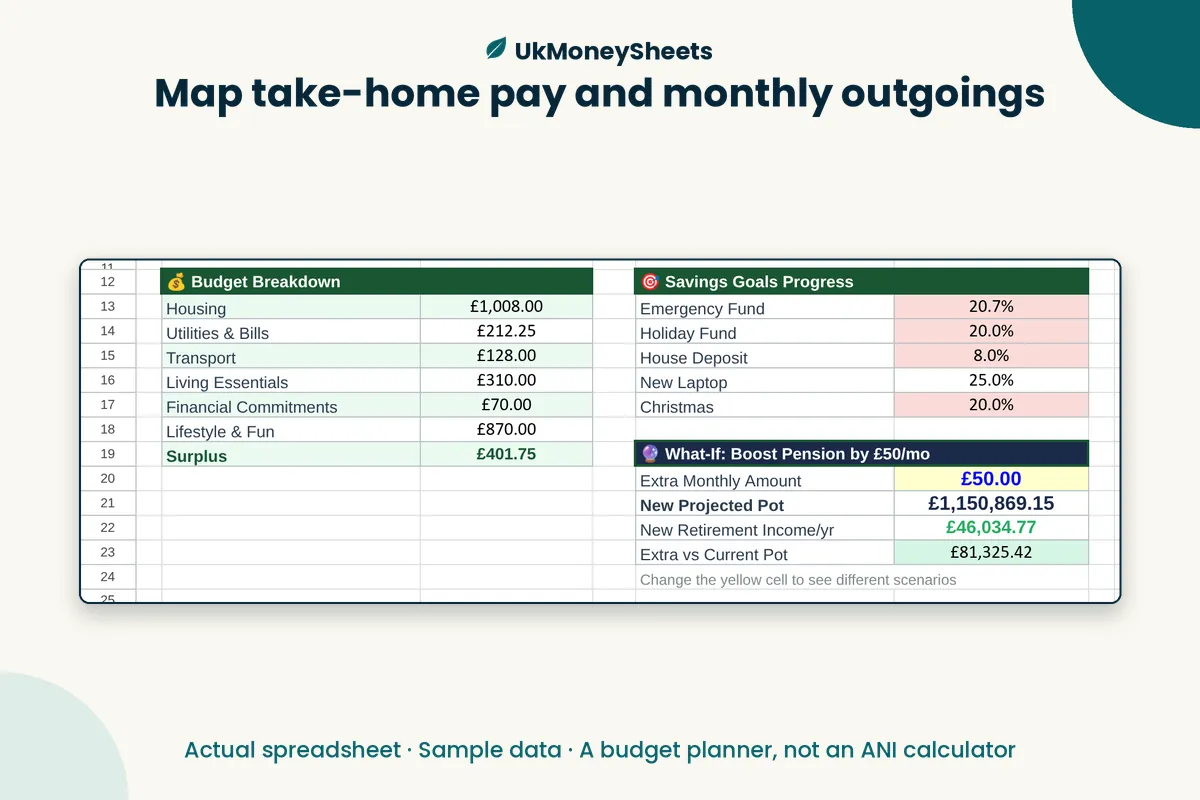
There's no dedicated UkMoneySheets ANI calculator. The worksheet above is a free example layout you can build in Google Sheets. If you want to plan take-home pay, pension and childcare costs month by month, the UK Salary / Monthly Budget sheet is the closest fit.
Planning pay, pension contributions and childcare costs across the year? The UK Salary / Monthly Budget Google Sheet helps you map take-home pay and monthly outgoings. It's not an adjusted net income calculator — use GOV.UK for the rules. You can browse the rest of the range in the UkMoneySheets shop.
Disclaimer
Not tax or financial advice. Rules, allowances and product names change — GOV.UK is the source of truth. Confirm the live Etsy listing before purchase. UkMoneySheets templates are Google Sheets only (never Excel), delivered as a PDF with a copy link, prices in GBP.
Browse UkMoneySheets on Etsy