Property
UK Landlord Spreadsheet: Track Rental Income for Self Assessment
To report UK rental income on Self Assessment, keep a clear record of rent received, allowable expenses, and residential finance costs by tax year — then use those totals when you complete the UK property pages.
This article is general information about record-keeping for landlords, not personalised tax advice. Rules change. Check current guidance on GOV.UK or speak to a qualified adviser or accountant before you file.
Who this is for
This is for individual UK landlords (and partners in a property partnership) who need to track rental income and costs for HMRC Self Assessment — often using the UK property pages (SA105).
You want Google Sheets, GBP, and UK tax years (6 April to 5 April), not a US Schedule E template.
Company landlords and complex structures have different rules. This guide focuses on the everyday sole landlord / individual property business who needs tidy books.
If you also have a side hustle, keep property income separate from self-employment (SA103) records — different forms, different boxes.
What to record for rental Self Assessment
GOV.UK expects accurate records of rent and expenses so you can work out taxable profit and show evidence if asked. Useful starting points:
- Work out your rental income
- Paying tax when you rent out a property
- Self Assessment: UK property (SA105)
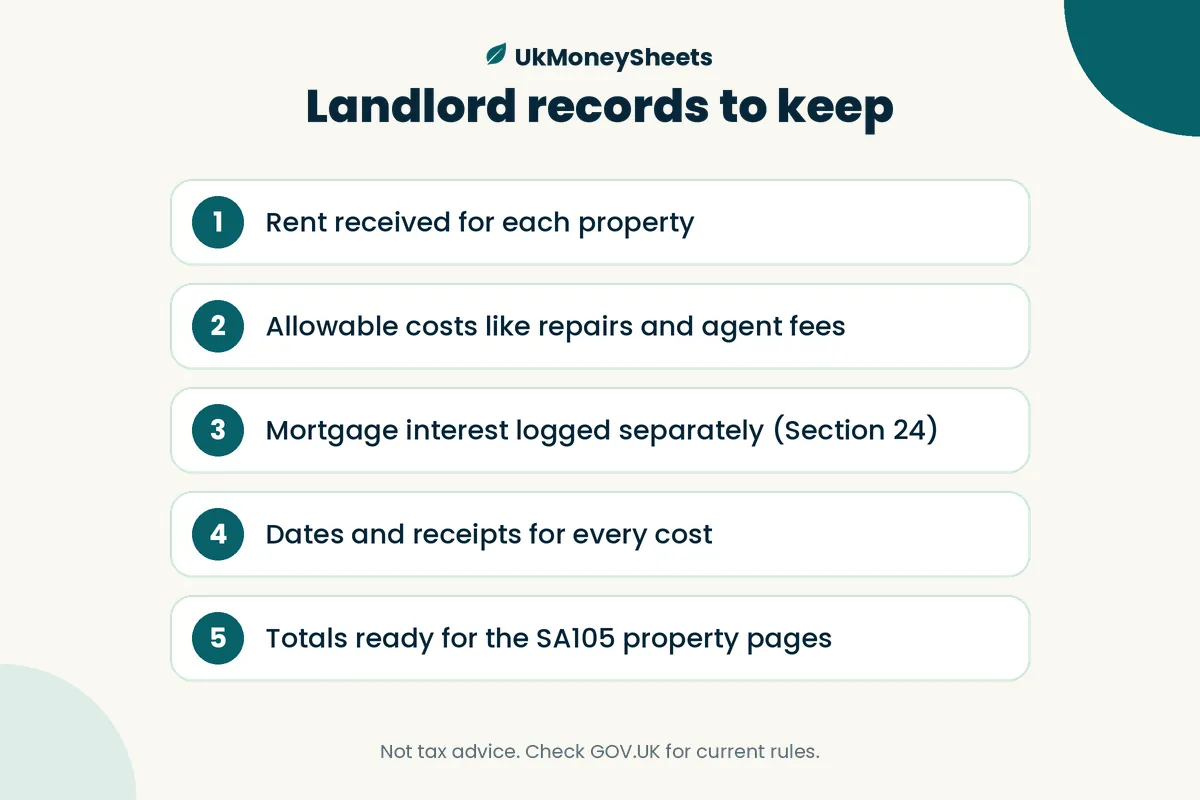
Plan to track at least:
- Rent and other property income — amounts and dates (gross rent before agent fees if that is how you reconcile statements)
- Allowable expenses — costs wholly and exclusively for the letting (see GOV.UK’s list: repairs, insurance, agent fees, utilities you pay, and similar)
- Dates and property — which flat or house each line belongs to
- Proof — invoices, agent statements, bank statements, rent books
Keep records for the period GOV.UK requires (for property income this is commonly at least 5 years after the 31 January deadline for the relevant tax year — confirm on the live guidance).
Whether you must register for Self Assessment, and when the property allowance applies, depends on your figures and situation. Use GOV.UK’s current thresholds rather than memorising a blog post.
Section 24 in plain English (finance cost restriction)
People often call the residential landlord finance-cost rules “Section 24” (from Finance (No. 2) Act 2015). In everyday terms:
For many individual residential landlords, mortgage interest and similar finance costs are no longer deducted in full when you calculate rental profit. Instead, relief is generally given as a basic-rate tax reduction after profits are worked out.
Official explanations (read these — do not rely on this summary alone):
- Tax relief for residential landlords: how it’s worked out
- Changes to tax relief for residential landlords
What that means for your spreadsheet:
- Still record mortgage interest and other finance costs carefully (date, amount, property, lender)
- Keep them clearly labelled as finance costs, separate from repairs and agent fees
- Do not assume your sheet’s “profit” line is the same as your taxable property profit after the restriction — your accountant or the SA105 notes will place finance costs in the right boxes
- Commercial property and companies can be treated differently — check GOV.UK if that is you
This article does not invent or guarantee a tax rate for your case. Basic-rate relief and transitional history are explained on GOV.UK; confirm the current position for the tax year you are filing.
Why generic US landlord sheets fail in the UK
US and “global” landlord templates often:
- Use a calendar year instead of the UK tax year
- Mix Schedule E categories that do not map to SA105
- Treat mortgage interest like a simple expense deduction every year
- Ignore UK agent statement formats and GBP
- Assume Excel desktop files
A UK landlord tracker should speak tax year, SA105-style income and expenses, and labelled finance costs — and run in Google Sheets if that is how you work.
Minimum columns for a landlord sheet
A practical ledger (one row per transaction):
- Date
- Property (address or short label)
- Type — Income / Expense / Finance cost
- Category — e.g. rent, agent fee, repair, insurance, ground rent, mortgage interest
- Description
- Amount (GBP)
- Tax year (e.g. 2025/26)
- Notes / invoice or statement ref
Optional: tenant or tenancy ID, payment method, “reconciled to agent statement?”
Worked mini-example (fictional only):
| Date | Property | Type | Category | Amount (£) | Tax year |
|---|---|---|---|---|---|
| 1 May 2025 | Flat A | Income | Rent | 1,100.00 | 2025/26 |
| 3 May 2025 | Flat A | Expense | Agent fee | 110.00 | 2025/26 |
| 5 May 2025 | Flat A | Expense | Boiler repair | 180.00 | 2025/26 |
| 15 May 2025 | Flat A | Finance cost | Mortgage interest | 420.00 | 2025/26 |
At year end, filter by tax year and property, total income, total allowable expenses, and total finance costs separately — then take those summaries to your return or accountant.
How the UkMoneySheets landlord spreadsheet fits
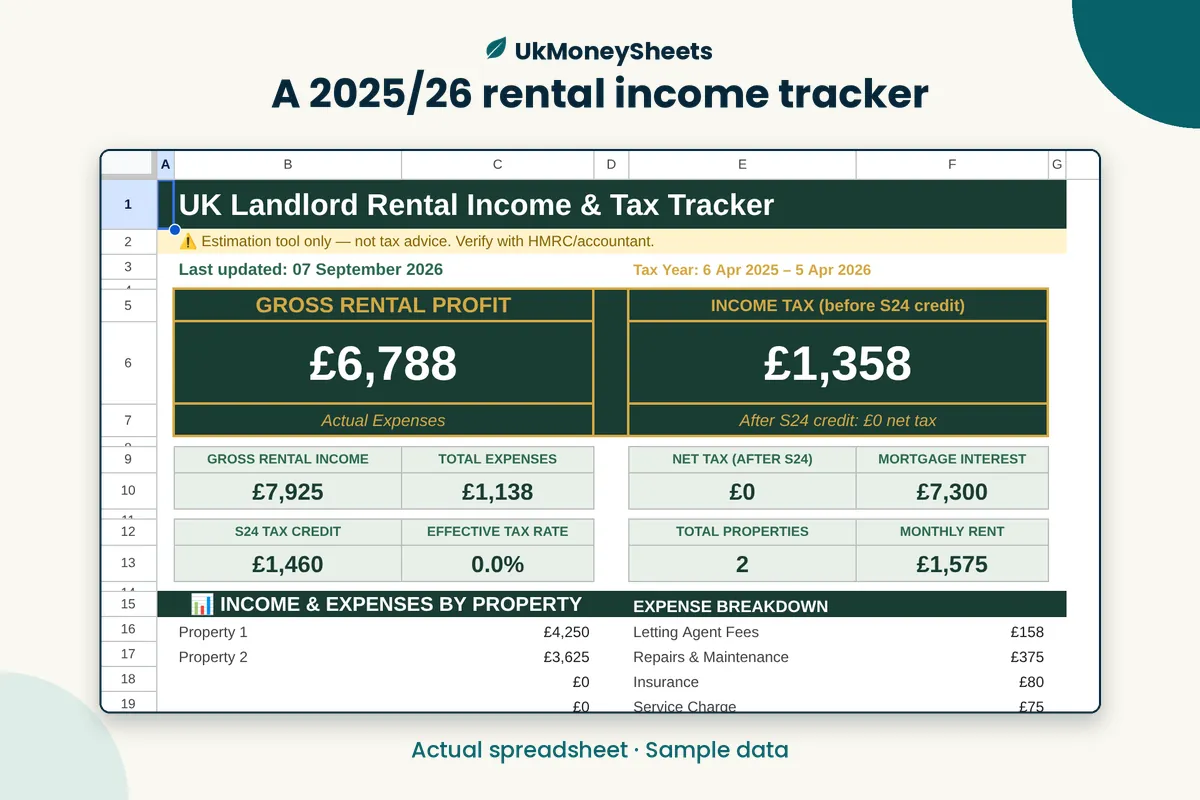
If you want a UK-ready layout, UkMoneySheets sells a UK Landlord Spreadsheet 2025/26 | Property Tax Self Assessment | Rental Income | Google Sheets.
It is built for Google Sheets (not Excel). Delivery is typically a PDF with the Sheets link so you can File → Make a copy into your Drive.
Related products if you also need personal tax or household tracking:
- Self Assessment / side-hustle tax sheets
- UK Money Toolkit bundle
A template organises figures. It does not file SA105 for you, calculate your Section 24 reducer, or replace an accountant for multi-property or higher-rate situations.
FAQ
Do I need Self Assessment as a landlord?
Often yes once rental income or profits cross the levels GOV.UK sets for reporting, or if HMRC asks you to file. Check paying tax when you rent out a property and register guidance for your year.
Can I put mortgage interest in with repairs?
Keep finance costs separate. Under the residential finance-cost restriction, they are usually treated differently from day-to-day allowable expenses. See GOV.UK’s landlord tax-relief pages above.
Is Section 24 the same for limited companies?
The restriction described for individuals does not work the same way for companies. If you let through a company, get advice and use the guidance that matches your structure.
Is this tax advice?
No. This article and any UkMoneySheets template are for organisation and education only.
Soft next step
Start a tax-year ledger with income, expenses, and finance costs in separate types. Reconcile to agent statements monthly.
If you want a UK Google Sheets layout aimed at rental Self Assessment, grab the UK Landlord Spreadsheet from UkMoneySheets on Etsy, make your own copy, and keep finance costs clearly labelled.
Then confirm every tax treatment on GOV.UK before you submit.
Disclaimer
Not tax or financial advice. Rules, allowances and product names change — GOV.UK is the source of truth. Confirm the live Etsy listing before purchase. UkMoneySheets templates are Google Sheets only (never Excel), delivered as a PDF with a copy link, prices in GBP.
Browse UkMoneySheets on Etsy